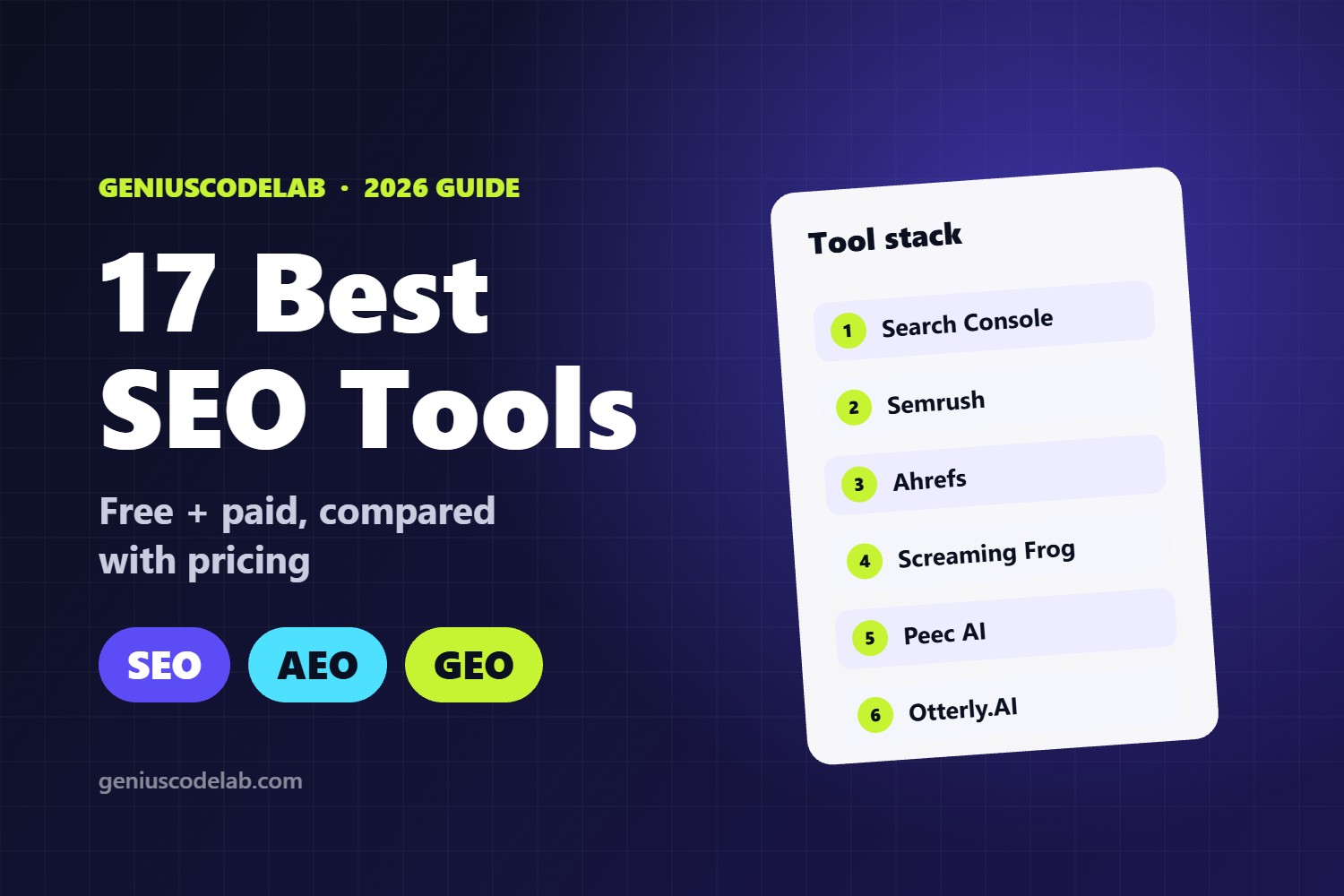
The best SEO tools in 2026 are Google Search Console (free), Semrush or Ahrefs (all-in-one research), Screaming Frog (technical audits), Yoast or Rank Math (WordPress on-page), Surfer (content optimisation) and an AI-visibility tracker such as Peec AI, Otterly or Profound for AEO and GEO. Most small businesses only need four tools to start:
- Google Search Console to see the queries, clicks and indexing issues Google reports for your site
- One all-in-one suite (Semrush, Ahrefs or SE Ranking) for keywords, competitors and backlinks
- Screaming Frog to crawl your site and fix technical issues
- One AI visibility tracker to check whether ChatGPT, Gemini, Perplexity and Google AI Overviews mention your brand
Ranking on Google is no longer the whole job. Buyers now ask ChatGPT, Gemini, Perplexity and Google’s AI Overviews for answers, and those engines pick a few brands to cite. So in 2026 you need tools for three jobs: SEO (rank in classic search), AEO (become the direct answer) and GEO (get cited by generative AI). This guide covers the 17 tools we use for client work at GeniusCodeLab, what each one is best at, what it costs, and the stack we would pick at each budget.
What is the difference between SEO, AEO and GEO?
SEO gets your pages ranked in search results. AEO (answer engine optimisation) shapes your content so a search engine or voice assistant can lift it as the direct answer. GEO (generative engine optimisation) makes your brand the source that AI models cite and recommend. All three build on the same foundation: crawlable pages, clear answers and a trusted brand.
The tool categories follow the same split. Classic SEO tools (Search Console, Semrush, Ahrefs, Screaming Frog) build the foundation. Question-research and schema tools (AlsoAsked, AnswerThePublic, Rich Results Test) cover AEO. A newer group of AI-visibility trackers (Peec AI, Otterly, Profound, Ahrefs Brand Radar, the Semrush AI toolkit) covers GEO.
Best SEO tools compared (2026)
Prices are approximate monthly starting prices as of October 2026. Vendors change plans often, so check the pricing page before you buy.
| Tool | Best for | Covers | Free plan | Starts at |
|---|---|---|---|---|
| Google Search Console | Real Google query and indexing data | SEOAEO | Yes, fully free | Free |
| Google Analytics 4 | Traffic, conversions and AI referral traffic | SEOGEO | Yes | Free |
| Bing Webmaster Tools | Bing and Copilot visibility, IndexNow | SEOGEO | Yes | Free |
| PageSpeed Insights | Core Web Vitals | SEO | Yes | Free |
| Semrush | All-in-one SEO and marketing suite | SEOAEOGEO | Limited + 7-day trial | ~$140/mo |
| Ahrefs | Backlinks and competitor research | SEOGEO | Free webmaster tools | ~$29/mo (Starter) |
| SE Ranking | Best value suite for small teams | SEOGEO | 14-day trial | ~$65/mo |
| Screaming Frog | Technical crawling and audits | SEOAEO | Up to 500 URLs | ~£200/year |
| Yoast SEO | WordPress on-page SEO and schema | SEOAEO | Yes | ~$99/year |
| Rank Math | Feature-rich WordPress SEO | SEOAEO | Yes | ~$8/mo |
| Surfer | Content optimisation briefs | SEOAEO | No | ~$99/mo |
| Clearscope | Content grading for editorial teams | SEOAEO | No | ~$129–189/mo |
| AlsoAsked | People Also Ask question mapping | AEO | 3 searches/day | ~$15/mo |
| AnswerThePublic | Question and long-tail ideas | AEO | Limited daily searches | Paid plans |
| Peec AI | AI citation and mention tracking | GEO | Trial | ~€89/mo |
| Otterly.AI | Affordable AI search monitoring | GEO | Trial | ~$29/mo |
| Profound | Enterprise AI visibility and AI crawler analytics | GEO | No | ~$99–499/mo |
The 17 best SEO tools for SEO, AEO and GEO
Filter by job. Each card says what the tool is best for, what it costs and one tip from our own client work.
Google Search Console
The only tool that shows you the actual queries, impressions, clicks and positions Google records for your site. It also reports indexing errors, Core Web Vitals and rich-result eligibility. Google counts AI Overviews and AI Mode appearances in your Performance report too.
- Best for
- Everyone. Set this up first.
- Price
- Free
Google Analytics 4
GA4 ties organic traffic to leads and sales. It also shows referral visits from AI assistants such as chatgpt.com, perplexity.ai, gemini.google.com and copilot.microsoft.com, which is the simplest free way to see whether GEO is working.
- Best for
- Measuring revenue from SEO
- Price
- Free
Bing Webmaster Tools
Bing’s index feeds Microsoft Copilot and several other AI search products, so Bing visibility matters more than its search share suggests. Bing Webmaster Tools gives you keyword data, a site scanner, backlink data and IndexNow for near-instant indexing of new URLs.
- Best for
- GEO groundwork and fast indexing
- Price
- Free
PageSpeed Insights & Lighthouse
PageSpeed Insights shows field data from real Chrome users (LCP, INP and CLS) next to a Lighthouse lab test. Fast pages rank better, convert better and get crawled more efficiently.
- Best for
- Speed and UX fixes
- Price
- Free
Semrush
The broadest suite on the market. It covers keyword research, position tracking, site audits, backlink analysis, competitor traffic estimates, local SEO and content tools. Its AI visibility toolkit tracks how often ChatGPT, Gemini, Perplexity and AI Overviews mention your brand.
- Best for
- Agencies and marketers who also run ads
- Price
- Pro from ~$140/mo; AI toolkit is an add-on
Ahrefs
Ahrefs has one of the largest live backlink indexes, a strong Site Explorer for competitor research and a clean keyword tool. Brand Radar is an add-on that tracks brand mentions and share of voice across AI assistants and AI Overviews.
- Best for
- Link building and competitor gap analysis
- Price
- Starter ~$29/mo, Lite ~$129/mo; Brand Radar extra
SE Ranking
It covers most of what the big two do (rank tracking, audits, keyword research, backlinks, local SEO and white-label reports) for a much lower price. It also tracks AI Overview and AI search visibility.
- Best for
- Small businesses and freelancers
- Price
- From ~$65/mo
Screaming Frog SEO Spider
The industry-standard crawler. It finds broken links, redirect chains, duplicate titles, missing meta descriptions, canonical problems, orphan pages and structured-data errors. It also connects to GSC, GA4 and PageSpeed so you see their data next to each URL.
- Best for
- Technical audits and migrations
- Price
- Free up to 500 URLs; ~£200/year licence
Yoast SEO
Yoast handles titles, meta descriptions, XML sitemaps, canonicals and a solid schema graph (Organization, Article, BreadcrumbList) out of the box. Its readability checks help you write the short, clear paragraphs that AI answers tend to quote. We run it on geniuscodelab.com.
- Best for
- WordPress sites that want stable, low-maintenance SEO
- Price
- Free; Premium ~$99/year
Rank Math
Rank Math’s free version offers more than most: several focus keywords per post, a schema generator, a 404 monitor, a redirection manager and GSC stats inside WordPress.
- Best for
- Power users who want many features in one plugin
- Price
- Free; Pro from ~$8/mo
Surfer
Surfer compares your draft against top-ranking pages and suggests the terms, headings, word count and topics you are missing. Its Content Editor scores the draft as you write.
- Best for
- Blog teams producing content at volume
- Price
- From ~$99/mo
Clearscope
Clearscope is simpler than Surfer and well liked by editorial teams. It grades content for topical coverage and works inside Google Docs and WordPress.
- Best for
- Brands with writers and editors
- Price
- From ~$129–189/mo
AlsoAsked
AlsoAsked pulls live People Also Ask data and shows how the questions branch from one another. That is close to how people (and AI engines) break a topic into sub-questions.
- Best for
- Planning FAQ sections and H2 structure
- Price
- Free (limited); from ~$15/mo
AnswerThePublic
AnswerThePublic groups autocomplete data into questions, prepositions and comparisons (“vs”, “for”, “near me”), which surfaces long-tail queries and conversational prompts.
- Best for
- Topic ideation and long-tail keywords
- Price
- Free daily searches; paid plans
Peec AI
Peec AI tracks a set of prompts across AI models and reports how often you are mentioned, where you rank among competitors and which URLs the AI cites. That last report tells you which sites to get featured on.
- Best for
- Brands that want practical GEO data
- Price
- From ~€89/mo
Otterly.AI
Otterly monitors brand mentions and links across ChatGPT, Perplexity, Google AI Overviews and others. It is a good entry point for small businesses trying GEO for the first time.
- Best for
- SMBs and agencies on a budget
- Price
- From ~$29/mo (Lite)
Profound
Profound is built for larger brands. It covers answer-engine tracking, sentiment, prompt-volume insights and AI crawler analytics that show how bots like GPTBot and PerplexityBot crawl your site.
- Best for
- Enterprise and high-competition categories
- Price
- From ~$99–499/mo; enterprise custom
Best SEO tool stack for every budget
You do not need all 17 tools. Pick the stack that matches your stage:
- Google Search Console + Bing Webmaster Tools for search data and indexing
- GA4 with an AI-referrals channel group
- Yoast SEO or Rank Math (free) for on-page and schema
- Screaming Frog free for up to 500 URLs
- Ahrefs Webmaster Tools for free backlink and audit data
- AlsoAsked / AnswerThePublic free tiers for questions
- Manual GEO checks: ask ChatGPT, Gemini and Perplexity your top 10 buying questions once a month and note who gets cited
- Everything in the free stack, plus
- SE Ranking (or Ahrefs Starter) for rank tracking and keyword research
- Screaming Frog licence for unlimited crawling
- Otterly.AI Lite to monitor AI mentions
- Rough total: ~$100–150/month
- Semrush Guru or Ahrefs Standard as the main suite
- Screaming Frog with GSC/GA4 connected
- Surfer or Clearscope for content at scale
- Peec AI or Profound (or Ahrefs Brand Radar / Semrush AI toolkit) for GEO
- Looker Studio dashboards that combine GSC, GA4 and AI visibility
- Rough total: ~$500–1,200/month
How do you choose the right SEO tool?
Choose by the job you need done, not by the length of the feature list. Ask these five questions:
- What is broken right now? Indexing or speed problems call for technical tools first. Pages that are indexed but not ranking call for keyword and content tools.
- Where does your data come from? Third-party tools estimate traffic. Search Console reports Google’s own measurements. Use estimates for competitors and GSC for your own site.
- Do you need local data? Location-based businesses need city-level rank tracking and Google Business Profile insights.
- Are buyers asking AI? In B2B, SaaS, education, health and high-ticket D2C, AI assistants already shape shortlists. Add a GEO tracker.
- Who will use it? A tool nobody opens is wasted money. Pick one suite and learn it properly.
A 30-day SEO, AEO and GEO workflow using these tools
- Days 1–3: Set up measurementVerify GSC and Bing Webmaster Tools, submit sitemaps, turn on IndexNow, and create the AI-referrals channel in GA4.
- Days 4–7: Technical crawlRun Screaming Frog. Fix 4xx/5xx errors, redirect chains, missing titles, duplicate meta and schema errors. Check Core Web Vitals in PageSpeed Insights.
- Days 8–12: Keyword and question mapPull keywords from Semrush, Ahrefs or SE Ranking and questions from AlsoAsked. Group them by intent and map one primary topic to each URL.
- Days 13–20: Answer-first contentRewrite your top pages. Open with a 40–60 word answer, use question-style H2s, add comparison tables and FAQs, and include original stats, examples and an author bio.
- Days 21–25: Schema and entity signalsAdd Organization, Article, FAQ, Product or LocalBusiness schema and validate it in the Rich Results Test. Make your name, address and phone number match on every profile.
- Days 26–30: Track AI visibilitySet up 15–25 prompts in Otterly, Peec AI or Profound. Record your baseline share of voice and the sources the AI cites, then go after those sources with PR, guest posts, reviews and community answers.
AEO & GEO checklist for 2026
Tick items off as you go. 0 / 12 done
- Each key page opens with a direct 40–60 word answer
- H2s and H3s are written as real questions people ask
- FAQ section with valid FAQPage schema
- Organization or LocalBusiness schema with logo and social profiles
- Named author with a bio and credentials on every article
- Original data, stats or case studies that are worth citing
- Comparison tables for “best” and “vs” queries
- robots.txt allows search and AI crawlers you want (Googlebot, Bingbot, OAI-SearchBot, PerplexityBot)
- Content is in the HTML, not hidden behind JavaScript or tabs that never load
- Consistent brand name, address and phone number across the web
- Pages show a visible “last updated” date and are refreshed regularly
- Brand mentioned on the third-party pages AI already cites
Note on llms.txt: some sites now publish an /llms.txt file for AI crawlers. It does no harm, but no major AI search engine has confirmed it uses the file for ranking or citations. Crawlable content, clear answers and third-party mentions still matter far more.
Frequently asked questions about SEO tools
What is the best free SEO tool?
Google Search Console is the best free SEO tool because it is the only one that shows Google’s own data on your queries, clicks, rankings and indexing. Pair it with Bing Webmaster Tools, GA4, the free version of Yoast or Rank Math, and Screaming Frog’s free crawler.
Is Semrush or Ahrefs better in 2026?
Semrush suits marketers who need SEO, PPC, content and social in one place. Ahrefs suits link building and competitor research thanks to its backlink index and simpler interface. Both now offer AI visibility tracking as an add-on. Small budgets can start with Ahrefs Starter or SE Ranking.
What tools are used for AEO (answer engine optimisation)?
The core AEO tools are AlsoAsked and AnswerThePublic for question research, Search Console for question-style queries, Yoast or Rank Math for FAQ and Article schema, Google’s Rich Results Test for validation, and Surfer or Clearscope to make sure answers cover the topic fully.
How do I track my brand in ChatGPT and AI Overviews?
Use an AI visibility tracker such as Peec AI, Otterly.AI, Profound, Ahrefs Brand Radar or the Semrush AI toolkit. You add the prompts your buyers ask, and the tool reports how often each AI engine mentions or cites your brand compared with competitors. GA4 shows the referral traffic that results.
What is GEO in SEO?
GEO, or generative engine optimisation, is the practice of making your brand appear in answers from generative AI such as ChatGPT, Gemini, Perplexity, Copilot and Google AI Overviews. It relies on clear, factual, well-structured content, strong entity signals, and mentions on the third-party sites those AI systems cite.
Do I still need SEO if people use AI search?
Yes. AI search engines retrieve web pages before they write an answer, so pages that are indexed, fast and well-ranked are far more likely to be cited. SEO is the foundation. AEO and GEO build on top of it.
How much should a small business spend on SEO tools?
Most small businesses can start at ₹0 with Google’s free tools and a free WordPress SEO plugin, then add one paid suite and a basic AI tracker for about $100–150 per month once content production is steady.
Want us to set this stack up for you?
GeniusCodeLab audits your site, fixes the technical issues, and builds SEO, AEO and GEO content that ranks on Google and gets cited by AI.
More from the blog: Deconstruct funnel breakdown · boAt funnel breakdown · Free marketing tools · Digital marketing services
Pricing is based on vendor pricing pages and public 2026 comparisons, checked October 2026. Prices are approximate and exclude taxes. Always confirm on the vendor’s site.
Leave a Reply